Railway History
These pages contain photos and information about local railway history.
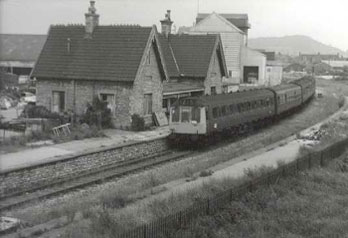
Last revenue earning train in Wells 1965. Photo courtesy of Paul Fry.
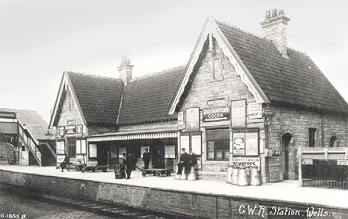
Wells Tucker Street Station 1885. Photo courtesy of Paul Fry.
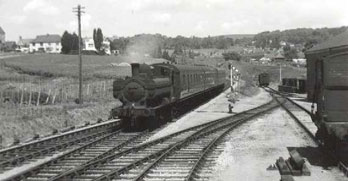
Train arriving from Wookey date unknown. Photo courtesy of Paul Fry.
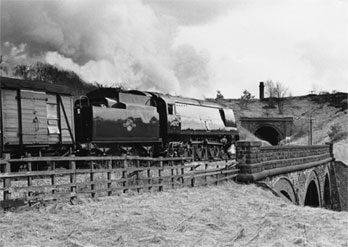
This picture was not taken in Wells, Somerset but it does show 4-6-2 number 34092 the City of Wells and was taken at Mytholmes Viaduct on the Keighley & Worth Valley Railway approx 1980 to 1985. The tender is a narrow one from another narrow cab engine, tender no. 3305. Photo courtesy of Peter Bowen.
City of Wells Railway History
Wells is a small cathedral city and civil parish in the Mendip district of Somerset, England, on the southern edge of the Mendip Hills.
The name Wells derives from the three wells dedicated to Saint Andrew, one in the market place and two within the grounds of the Bishop's Palace and Wells Cathedral. During the Middle Ages these wells were thought to have curative powers.
Although the population, recorded in the 2001 census, is only 10,406, it has had city status since 1205.
Railways in Wells, Somerset
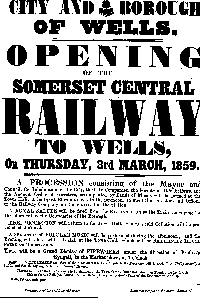
Wells has had three railway stations. The first station, Priory Road, opened in 1859 and was on the Somerset Central Railway (later the Somerset and Dorset Joint Railway) as the terminus of a short branch from Glastonbury.
Wells station in the Somerset city of Wells was the terminus of the East Somerset Railway line from Witham and opened when the line was extended from Shepton Mallet in 1862.
The station was only 100 yards or so from Wells' first station, the terminus of the Somerset Central Railway branch from Glastonbury, which had opened in 1859, and which would later be renamed as Wells (Priory Road). The East Somerset Railway, though nominally independent, was controlled by the Great Western Railway.
In 1870, the Cheddar Valley line from Yatton railway station also reached Wells, where a third station, later to be known as Wells (Tucker Street) was opened. This line too was controlled by the GWR and in the late 1870s a spur line was built to connect the Cheddar Valley line to the East Somerset line, passing through the Priory Road station, though trains did not stop there until 1934. This connecting line opened in 1878, at which time the original East Somerset Railway station in Wells closed, and GWR traffic was concentrated on Tucker Street.
The station building, minus its canopy, was later used as a cheese factory by a company called Marsh and Adams, but was destroyed by fire in 1929. The line through the site continued in operation until closure in 1963.
Matters were somewhat simplified when the Great Western Railway acquired both the Cheddar Valley and the East Somerset lines and built a link between the two that ran through the S&DJR's Priory Road station.
In 1878, when through trains began running between Yatton and Witham, the East Somerset station closed, but through trains did not stop at Priory Road until 1934.
Priory Road closed to passenger traffic in 1951 when the S&DJR branch line from Glastonbury was shut, though it remained the city's main goods depot. Tucker Street closed in 1963 under the Beeching Axe, which closed the Yatton to Witham line to passengers. Goods traffic to Wells ceased in 1964.